
Custom Perfume Manufacturing: What Changed for Kids-Safe Lines
Custom perfume manufacturing has changed more in the last decade than in the decades before it, and the changes point in one direction: buyers can now specify safety with precision instead of hoping. Ingredient data is public, testing starts earlier, packaging safety is a specifiable component, and the documentation trail is treated as part of the product. For a kids-safe brief, every one of these shifts is good news — but only if you use them.
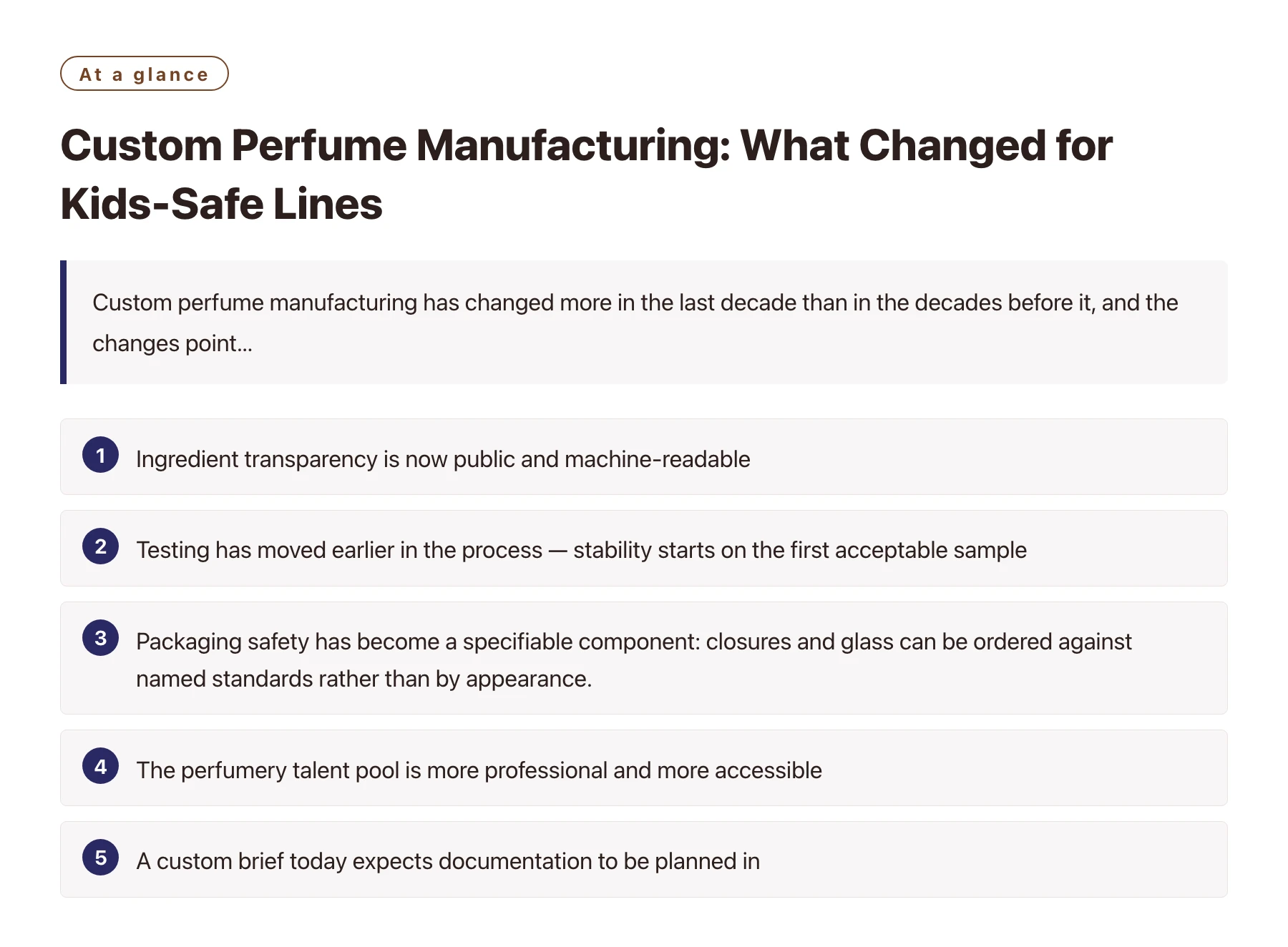
Key takeaways
- Ingredient transparency is now public and machine-readable, which shrinks the information gap between a buyer and a formulator.
- Testing has moved earlier in the process — stability starts on the first acceptable sample, not after final approval.
- Packaging safety has become a specifiable component: closures and glass can be ordered against named standards rather than by appearance.
- The perfumery talent pool is more professional and more accessible, with formal training routes beyond apprenticeship.
- A custom brief today expects documentation to be planned in, because importers and retailers treat a missing file as a missing capability.
If you commissioned a custom fragrance ten years ago and again today, the two projects would look similar from the outside — brief in, samples out, bulk order — but almost nothing under the surface would be the same. The change matters most for a kids-safe line, because the category depends on exactly the things that shifted: evidence, transparency and specification.
The five shifts below are the ones that have practical consequences for a brand commissioning custom development now.
Five shifts that changed the category
None of these changes arrived as a single event; they accumulated through regulation, consumer pressure and better tools. Together they rewrote what a buyer should expect from a custom fragrance project.
1. From secrecy to public ingredient data
A generation ago, what went into a fragrance was the formulator's business. Today the EU maintains a public cosmetics ingredient database where a buyer can look up how individual substances are regulated, so restriction status is verifiable without being a chemist [1]. The practical effect: your brief can name what you want avoided, and the factory's answer can be checked.
2. Testing moved earlier
Stability and compatibility used to be scheduled after the scent was final, which pushed launches into the test report. The shift is to start the clock on the first acceptable sample, so the report matures in parallel with design. For a kids-safe format this is decisive — the closure and glass are tested together with the formula, not as an afterthought.
3. Packaging safety became a specifiable component
Child-resistant fastenings, drop-rated glass and migration-safe decoration can now be ordered as verified components against named standards. The change is cultural as much as technical: factories that serve safety-conscious categories stock and quote these parts as standard lines rather than treating them as customs. That is what makes a kids-safe pack a specification instead of a wish.
4. The talent pool professionalised
Perfumery is still a craft, but it is a more open one. Formal training routes now sit alongside long apprenticeships, and the industry's skills base has widened as fragrance houses and academies publish their methods. For a buyer, the effect is that the people developing your brief are more likely to hold structured training — and more likely to welcome structured requirements from you.
5. Documentation became part of the product
The most visible shift for buyers: a custom project now ships with a file. Formula reference, ingredient review, stability plan, label check, batch records — importers and retailers treat this file as part of the goods. Manufacturers who export regularly have normalised it, and buyers should expect the file to be planned into the schedule rather than assembled in a panic.
Then and now, in practice
| Aspect | A decade ago | Now |
|---|---|---|
| Ingredient data | Behind the formulator's desk | Public databases, verifiable in the brief |
| Stability timing | After final approval | From the first acceptable sample |
| Child-resistant closure | A special order, rarely stocked | A stocked, tested component with a report |
| Perfumer training | Mostly apprenticeships | Formal courses alongside craft routes |
| Documentation | What the buyer could extract | A planned part of the delivery |
| Buyer's brief | Family, price, performance | Family, price, restrictions, formats, markets |
Read the last row as the summary of the whole table: the brief has become the product. Everything else in the list is the industry catching up with that fact.
What this means for your next brief
The practical takeaway is that a well-written brief does more work than it used to. You can now include a restriction philosophy, a closure expectation, a testing timeline and a market list, and the factory has both the tools and the habit to answer concretely. The factories that have absorbed these shifts are the ones that treat ingredient, testing and packaging questions as routine — and they are also the ones easiest to audit.
The parallel shift in the industry's wider context: new fragrance materials and the chemistry behind them are now discussed in mainstream scientific journalism, which gives a non-specialist buyer a window into what has actually changed rather than what marketing claims [2]. Reading a little of it before the first meeting makes the meeting shorter.
Skills are part of the same story. Formal education in perfumery has expanded beyond a handful of houses, and a buyer commissioning custom work can reasonably expect the development team to have structured training behind it — the kind of training offered at a place to learn perfumery (a place to learn perfumery) or its equivalent. You do not need to verify diplomas; you need to notice whether the team speaks in method or in anecdotes.
The commercial context has shifted too: contract perfume manufacturing in China (contract perfume manufacturing in China) now routinely serves brands that arrive with restriction lists and test schedules, which means the capability you need for a kids-safe line is not exotic — it is the new baseline. What still separates factories is how consistently they apply it.
When you are choosing a custom perfume factory (custom perfume factory) for a kids-safe project, ask one question that none of these shifts has made obsolete: show me how this list of changes appears in your process. The factory that answers with its ingredient review, its early stability habit and its closure stock is telling you it already lives in the new normal.
The changes described here favour the prepared buyer. The gap between factories is no longer access to information — it never was, for this category — but willingness to organise work around the information. Judge the factory by its process answers, not its brochure.
Sources
- EU CosIng — Cosmetic Ingredient Database (European Commission) —— The European Commission's CosIng database of cosmetic ingredients, listing ingredient functions, restrictions and labelling requirements under EU cosmetics law.
- Chemistry World (Royal Society of Chemistry) —— The Royal Society of Chemistry's magazine, covering chemistry research and explanations of everyday materials including aroma compounds.
Frequently asked questions
Do I need to understand ingredient chemistry to commission a custom fragrance?
No, but you should be able to state preferences and check answers. The public ingredient databases and restriction frameworks are designed to be usable by non-chemists: name what you want avoided, ask the factory for its review, and spot-check the key claims.
Why is testing starting earlier than it used to?
Because the alternative — testing only after final approval — made the test report the critical path of the launch. Starting on the first acceptable sample lets stability and compatibility mature while the design is still being finished, which shortens the schedule and gives the evidence time to be real rather than rushed.
Are child-resistant closures now standard stock?
At factories that serve safety-conscious categories, yes — they are stocked, verified components rather than special orders. That matters because a stocked tested closure comes with a report and a known price, while a custom one adds tooling time and uncertainty to the schedule.
Has the perfumery talent shortage changed?
The industry has widened its entry routes with formal training alongside traditional apprenticeships, but experienced perfumers are still scarce and committed to long projects. Plan for the perfumer's time as a real constraint in your schedule and you will avoid the most common custom-development delay.
What should a modern custom fragrance file contain?
A complete file normally includes the formula reference, the ingredient restriction review, stability and compatibility reports, the closure and packaging test evidence where applicable, and the label check against target markets. Every market in your plan should have a named document that covers it.
This Thursday: The Critic's Cut
One long-form review, one shorter polemic, and what we're reading against — delivered to 62,000 inboxes every Thursday morning. No ads, no denomination, no spin.
Read This Week's Review